From cars to artillery
8. July 2026
23. June 2026 - from Dr Theodor Benien
In the struggle for a new world order, the EU is often criticised for being too hesitant, too fragmented, and too weak. Unlike the US, Russia, and China, Europe is not a superpower. Nevertheless, in the long term, European nations have the potential to play an important role on the global stage.

“A sovereign Europe is our best response to the new era. Uniting and strengthening Europe is our most important task today.”
Federal Chancellor Friedrich Merz in his speech at the Munich Security Conference 2026.
To turn this aspiration into reality, two fundamental tasks need to be accomplished. European governments should resolutely accelerate Europe’s political integration process and refrain from unilateral national actions in order to finally grow together as a true union. Additionally, they must expand not only their political and economic power, but also their military strength – hence, their ability to defend themselves.
Pressure from all sides
The political pressure on Europe is enormous and comes from different directions. Firstly, President Vladimir Putin wants to restore Russia to its former glory and is therefore seeking to change the security architecture in Europe. He considers the collapse of the Soviet Union to be the greatest political catastrophe in his country’s history. Secondly, China is both a partner and a competitor. As a systemic rival, the People’s Republic is pursuing an expansionist course and is attempting to extend its influence, including in Europe. Thirdly, US President Donald Trump is shaking up the existing transatlantic rules of the game. Washington is demanding that Europeans take on more responsibility and invest more in defence. The key question is whether Europe can still rely on US protection.
Polish Prime Minister Donald Tusk summed up this precarious situation succinctly. It can’t possibly be that 500 million Europeans are constantly asking 300 million Americans to protect them from 140 million Russians, who have been unable to defeat 40 million Ukrainians for more than four years.
A united Europe as the key to lasting stability
Europe is compelled to respond to these profound challenges. But what can be done? Here are a few suggestions. Politically, individual states need to work more closely together so that Europe can turn into a powerful entity. Economically, the continent must continue to improve the conditions that facilitate sustainable growth and international competitiveness. Industrially, consolidation in Europe’s defence industry, for example, should be resolutely promoted. This high-tech sector is still too fragmented and oriented towards individual countries. Militarily, Europe must expand the capacities and capabilities indispensable for playing a serious role on the global stage.
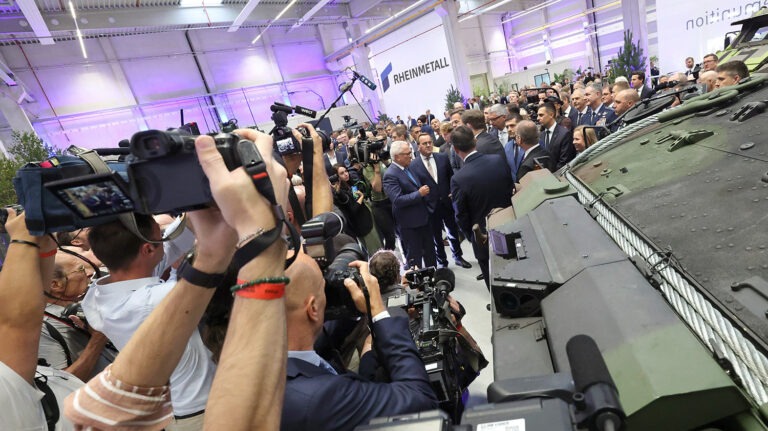
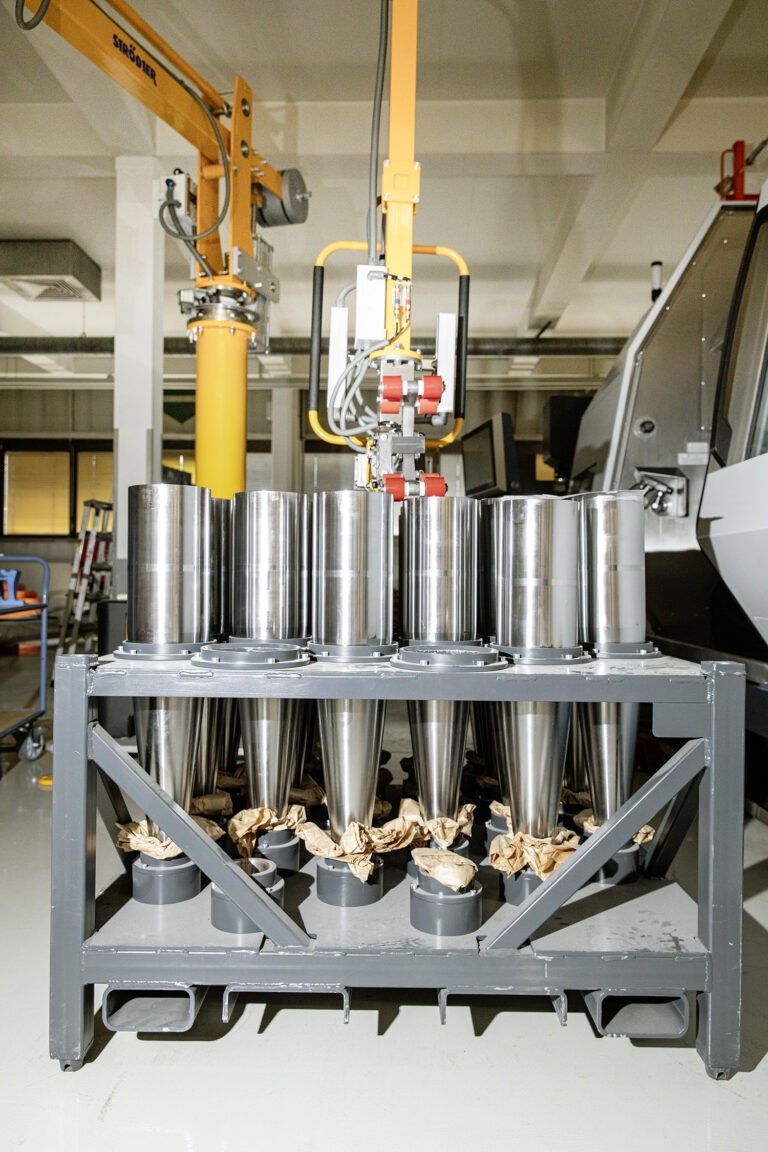
Therefore, the EU has decided to invest an additional €800 billion in defence. This includes EU loans (SAFE) totalling €150 billion, as well as exempting defence spending from EU debt rules. Further proposals are set out in the EU’s new “White Paper for European Defence – Readiness 2030”. The aim is to strengthen European sovereignty and strategic autonomy, and to reduce dependence on the US. This was summed up concisely by German Defence Minister Boris Pistorius at the inauguration of the new artillery ammunition plant in Unterlüß on 27 August 2025: “NATO must become more European so that it remains transatlantic.” Needless to say, NATO is and will remain Europe’s indispensable security guarantor.
Economically a giant – politically a dwarf?
Europe’s limited scope for action was revealed in August 2025 (once gain) when its leaders would have liked to attend the talks between Trump and Putin in Alaska. It was not until the subsequent Ukraine summit in Washington, DC, however, that a delegation of European heads of state and governments was given the opportunity to present their proposals to the US President. One way for Europe to increase its geopolitical influence is to work with the US to find a peaceful solution to the conflict in Ukraine. This would demonstrate Europe’s political will to become a world power.
Europe’s limited scope for action was revealed in August 2025 (once gain) when its leaders would have liked to attend the talks between Trump and Putin in Alaska. It was not until the subsequent Ukraine summit in Washington, DC, however, that a delegation of European heads of state and governments was given the opportunity to present their proposals to the US President. One way for Europe to increase its geopolitical influence is to work with the US to find a peaceful solution to the conflict in Ukraine. This would demonstrate Europe’s political will to become a world power.
At present, Europe is not yet strong enough. However, Europeans have the potential, capabilities, and strength to achieve this long-term goal, even if the path to it is very difficult.
Dr Theodor Benien
worked as Head of Communications for over 30 years in various divisions of the Airbus Group. He also served as Vice President Communications at the Eurofighter consortium. Since 2020, he has been working as an independent communications consultant specialising in international security and defence policy.

Click here to receive push notifications. By giving your consent, you will receive regular updates about new articles on the Dimensions website. This notification service can be cancelled at any time in your browser settings or your mobile device settings. Your consent expressly also covers data transfers to third countries. Further information can be found in our privacy policy under Section 5.