Pinktober – together against breast cancer
2. October 2026
23. June 2026
Security of supply as a foundation: in an ever-changing world, Rheinmetall’s purchasing department and its team are mastering the “turning point”. In an interview, Chief Purchasing Officer Marcus Gerlach explains how the Group manages global supply chains, minimises risks, and ensures production stability despite the enormous demand for defence equipment.
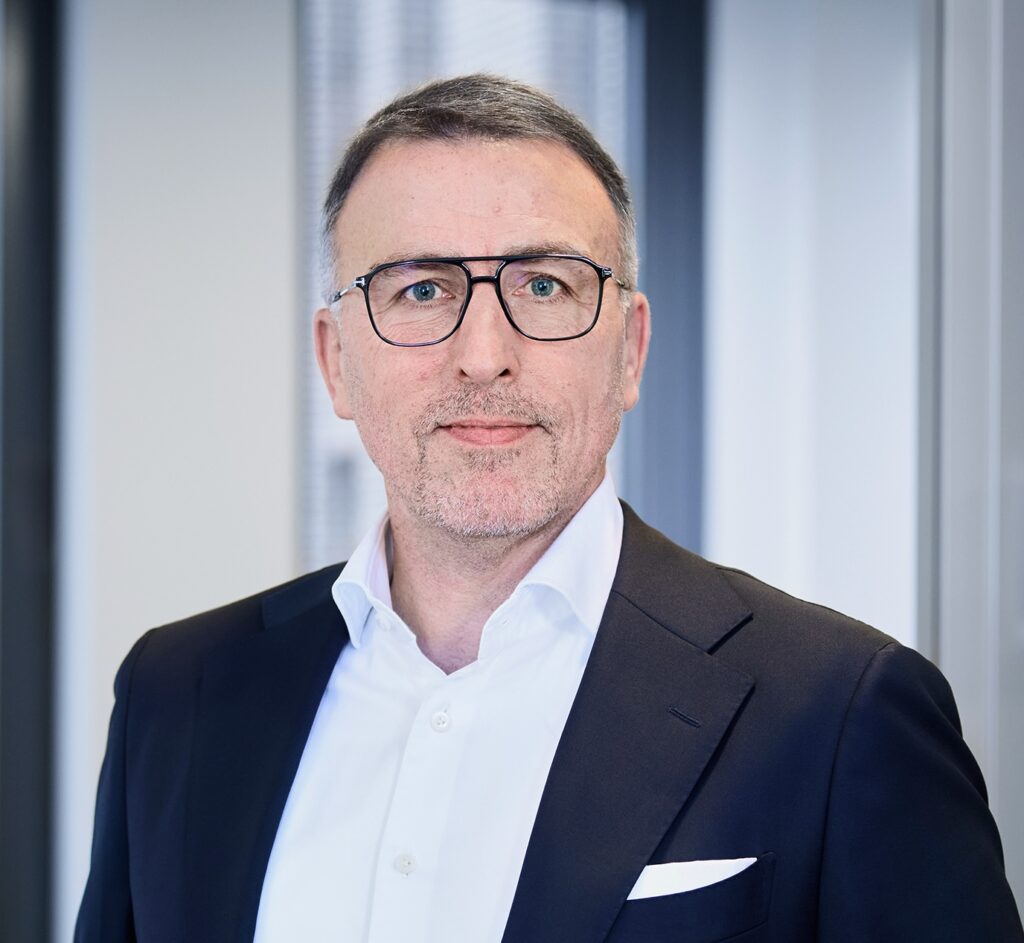
Marcus Gerlach,
born in 1971, offers a comprehensive overview of Rheinmetall: 27 years with the Group, 12 positions, 5 functional areas, across 3 continents. Since 1 January 2023, Rheinmetall AG’s Group-wide procurement activities have been consolidated within the Rheinmetall Group Purchasing unit under the direction of his team. As Chief Purchasing Officer (CPO), he reports directly to René Gansauge, Chief Operations Officer of Rheinmetall AG.
Mr Gerlach, you are probably the largest purchaser of armour steel in Germany. Your background is in Rheinmetall’s automotive division, and now you have to master the turning point. How does that feel?
This is a major challenge that we must all face. I am tackling it with great enthusiasm. Since the change of government in Washington in early 2025, and certainly since Vice President Vance’s speech in Munich shortly after, the dynamic has been completely different, with a new sense of urgency. Everything has to move even faster, including the supply chains. Incidentally, we will be purchasing over 100,000 tonnes of steel this year, around 15 per cent of which will be armour steel.
So, it’s about more than just making a bargain …
Purchasing is a central strategic function within the Group. The primary focus is not on reducing costs, but rather on increasing volume and scaling up, while ensuring security above all else. We must be resilient and ready to deliver at all times. This is how we strengthen the security of Germany, Europe, and NATO.
A great challenge …
Yes, definitely. What we have to implement now is coming up against a supply chain that had no significant capacity for a long time during the “peace dividend” era. Everyone was in a deep sleep, and now the demand is: “Fast – and much more!” We now have to go for a sprint without much of a warm-up, but running the distance of a marathon.
The Group’s strong growth is certainly helpful in this regard …
Indeed. Given the weak volumes of the past, it simply wasn’t economically viable to bring in a second or third supplier. The sole supplier knew they were set for life and naturally acted accordingly when setting prices. Things are different today. However, our existing suppliers remain important to us, and they benefit from our cooperation: our growth is so strong that they grow with us. And not on their own anymore.
What is the volume for which the central purchasing department is responsible?
We see ourselves as a collective purchaser, as our focus is on cooperation across all divisions. With a consolidated turnover of just under €10 billion, we purchased production materials worth €4.4 billion in 2025, which amounts to around 45 per cent of the turnover. A further €1.5 billion was spent on investments, such as the construction of new plants and machinery. In total, our purchase volume therefore amounts to around 60 per cent of the turnover.
That’s impressive. How big are the savings which you and your team achieve?
It is actually quite a lot. Depending on the project, we sometimes achieve significant cost savings. This is thanks to our 1,030 colleagues working in Group Purchasing across the entire Group, 980 of whom are in operational roles. The remaining 50 colleagues coordinate our activities, ensuring that we are a unified front: one face to the supplier.
Could you give us an example of your team’s work? What is important here?
First and foremost, we need matrix capabilities: everyone must be willing to work together. This is especially true for the product groups, which we have organised into so-called commodity teams. Take the purchase of screws, for example: the commodity manager has overall responsibility for this area. At each site, they work closely with colleagues who purchase screws locally. They regularly exchange information and develop commodity strategies together. Ultimately, we compile a bidders list, which evaluates the performance of suppliers.
You need to know what the requirements are at each site. Does the Group have enough standardised data for the purchasing department to work efficiently?
We’re making progress, but there’s still much to do. We have now largely standardised the supplier master data across all companies. It’s similar with material master data, where we use the so-called UNSPSC codes. This is a United Nations product classification system that gives us a clear overview.
Rheinmetall is one of the fastest-growing companies in Germany. This makes it an attractive choice for potential suppliers. Are suppliers queuing up to do business with you?
Yes, we do receive applications in the four-digit range every year. But not every supplier that has previously produced large volumes for a car manufacturer can operate profitably with our comparatively low quantities. We welcome any supplier who can help us expand our network. However, the quickest way to increase volumes, as is now expected of us, is to work with existing suppliers. They are already established and approved by the customer. New suppliers are only brought in as a second step.
In the past, supplying the defence industry was considered a stain on a company’s reputation. Is this now changing?
Absolutely. Many well-known companies, ranging from mid-sized businesses to large-scale industries, are now actively seeking to establish business ties with Rheinmetall. We have become a highly attractive partner, and many wish to be part of our success. The importance of national security, and consequently of rearmament, is also having an impact.
Are there any indicators or criteria that make a supplier particularly attractive to Rheinmetall?
Secure supply chains are essential to us. If they are also local, all the better. We can then operate in a more environmentally sustainable way and minimise risks within the process. Naturally, we expect our suppliers to accept our Supplier Code of Conduct, in which we clearly set out our expectations regarding good corporate governance.
Meeting ESG criteria – that is, environmental, social, and governance criteria – is surely another decisive factor?
Certainly. Acting in accordance with ESG or CSR principles is, of course, part of our corporate strategy at Rheinmetall. We use rating systems such as EcoVadis and rating agencies to evaluate our suppliers in this regard. We also emphasise the importance of building personal relationships with our suppliers, so that we can continuously assess their transparency.
You’ve spent three years at the top of Group Purchasing. What stands out most in your memory?
The biggest highlight for me was the successful construction of the artillery plant in Unterlüß. We supported this project throughout the purchasing process from the very beginning. When CEO Armin Papperger said at the ground-breaking ceremony on 12 February 2024, “The plant will be ready in 15 months”, I was sceptical, to put it mildly. But we did it – a wonderful experience! Everyone was committed to the common goal. The purchasing team focused on adhering to schedules while securing the best possible deals.
What part does Group Purchasing currently play in ensuring the supply of rare earths and other critical raw materials?
We have taken precautions. We have significantly increased our stocks, so we won’t face any issues in the short term. However, there are still certain dependencies at the lower levels of the supply chain – the so-called Tier N levels – concerning countries such as China. However, we are working on reducing these dependencies. To this end, we are using risk management tools and examining the supply chains to receive the greatest possible transparency. This allows us to identify where difficulties exist at each level. Our development division is also making valuable contributions, such as approving alternative materials.
Let’s continue with China: how do you reduce strategic dependencies?
We achieve this through consistent diversification and technological innovation. Our figures show that we are on the right track. Of a total purchase volume of €4.4 billion for production materials, we sourced 88 per cent – almost €4 billion – entirely “China-free” in 2025. Where there are global dependencies on raw materials such as rare earths, we focus either on the targeted redesign of our products or on developing new supply chains.
What happens to all the scrap that inevitably accumulates?
Of course, we mustn’t overlook the circular economy at the end of the process, like recycling and the scrap management process. We should consider our scrap as strategic raw materials and keep it within Europe. We need to use scrap and recycling routes remaining within our borders as a strategic competitive advantage.
How do you assess European efforts to achieve self-sufficiency in raw materials?
They are right, but far too slow and hesitant. Germany needs a raw materials strategy that aligns with the European Critical Raw Materials Act. Rapid action is of the essence here, too.
The company is set for massive growth and aims to almost quadruple its turnover by 2030. What does that mean for you?
Our supply chains must grow alongside the Group. Division of labour, the ability to collaborate, and scalability are crucial in this regard. Digital tools will help us achieve all of this as we move forward. It will be essential that we design our products to be fully scalable, producing more of the same to reduce the number of variants and thus enable growth.
Rheinmetall is discontinuing its former automotive division. Will this free up capacity within the purchasing organisation?
I had the privilege of working in the Automotive division for many years. It was structured to be self-sufficient and organised, with a high degree of autonomy. Therefore, the separation will have little impact on our work in Group Purchasing. However, within the Group, we will continue to benefit from the focus on process efficiency that has always characterised the Automotive division. The division has set the standard, particularly regarding supplier quality development in the early stages of projects.
What inspires and motivates you every day to advance purchasing at Rheinmetall?
For me, working at Rheinmetall means pursuing a mission of profound meaning. Our guiding principle is: “We procure freedom”. We therefore take on the responsibility of establishing the foundations of peace and freedom by ensuring secure supply chains. Every decision we make contributes to this – and that is what drives my team and me. It certainly fulfils us.
Mr Gerlach, thank you very much for this insightful conversation!
The interview was conducted by Maja Schmidtke and Oliver Hoffmann.

Click here to receive push notifications. By giving your consent, you will receive regular updates about new articles on the Dimensions website. This notification service can be cancelled at any time in your browser settings or your mobile device settings. Your consent expressly also covers data transfers to third countries. Further information can be found in our privacy policy under Section 5.