From cars to artillery
8. July 2026

Hardly any other product group is subject to stricter controls than military equipment. National laws, European regulations and directives, international conventions: a closer look at the regulation of arms exports dispels misconceptions and offers a new perspective on the security and defence industry.

Weapons are being misused worldwide to violate human rights and breach international humanitarian law, whether they are in the hands of Somali paramilitaries, Islamist terrorist groups, or pirates on the Nigerian coast. Behind this lies a global illegal market. These examples alone demonstrate the considerable dangers posed by the unregulated trade in arms. Nevertheless, weapons are necessary for maintaining internal security, defending the nation and its alliances, ensuring peace through deterrence, and carrying out military and humanitarian missions.
In Germany, this ambivalence is primarily governed by the Basic Law (constitution): acts intended to disrupt the peaceful coexistence of nations or to prepare for a war of aggression are unconstitutional and will be punished. The federal government must approve the production, transport, and sale of weapons which are intended for warfare (“weapons of war”), and this naturally also applies to Rheinmetall. Other armaments, including weapons and ammunition, that are not weapons of war are also subject to strict state approval and secondary obligations.
No export without controls
The Federal Republic of Germany has one of the strictest export control systems in the world. In addition to the Basic Law, German arms exports are governed by the War Weapons Control Act and the Foreign Trade and Payments Act (AWG) in conjunction with the Foreign Trade and Payments Ordinance (AWV). This serves the purpose of maintaining peace and preventing war. It regulates the production, transfer, placing on the market, acquisition, and transport of items, substances, and organisms that are classified as weapons of war. The law clearly defines what is considered to be a weapon of war – the intended purpose is a particularly crucial factor. Examples include main battle tanks, armoured combat support vehicles, machine guns, certain types of ammunition, warships, and fighter aircraft.
Also, the export of other military equipment is regulated by law. For example, the export of weapons and ammunition is governed by the Weapons Act, while the export of explosives is governed by the Explosives Act. The relevant export licences are required depending on the end users.
Every step requires approval
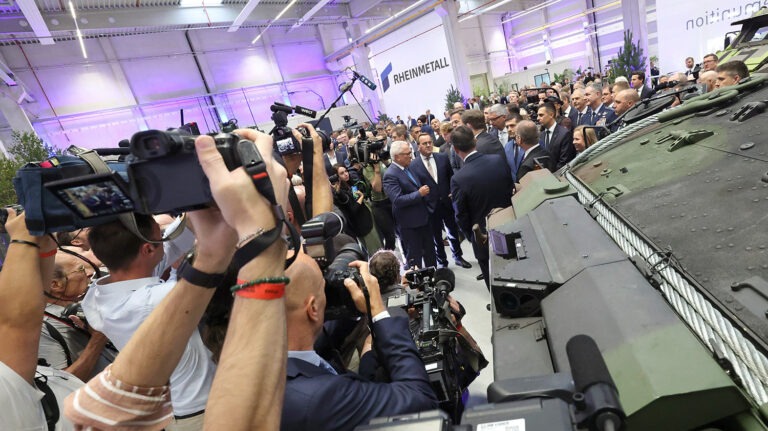
Any production, storage, or transport of weapons of war and other types of weapons and ammunition, even within Germany, requires a licence under the relevant legal provisions, even within Germany. This also applies to the transport by German ships or aircraft outside German territory, also comprising imports, exports, and transit. At Rheinmetall, employees in the operating companies who have received the necessary training and possess sufficient experience ensure strict compliance with these regulations. Every delivery and every transport must be reported, even when a Puma infantry fighting vehicle, for example, is transported to an exhibition at the Day of the Bundeswehr in Wunstorf. So-called dual-use items, which can be used for both civilian and military purposes, are controlled by the Federal Office for Economic Affairs and Export Control (BAFA). These include chemicals, electronics, machine tools, software, and technology.
The federal government’s political principles also limit the discretion of the licensing authorities. One key element is the end user’s compliance with human rights. If there is reasonable suspicion that the military equipment will be misused for internal repression or other ongoing, systematic human rights violations, the export is prohibited. Furthermore, Germany distinguishes between EU and NATO countries, NATO-equivalent countries (Australia, New Zealand, Japan, and Switzerland), and third countries. The German government authorises exports to third countries only where, in individual circumstances, particular foreign or security policy interests of Germany are involved – for example in counterterrorism or efforts to combat international drug trafficking. In critical cases, the Federal Security Council, which meets in closed sessions, decides on the export licence. As a general rule, a licence for the export of armaments is only granted if it is guaranteed that they remain in the recipient country. The end user must usually confirm this with an end-use certificate. Following delivery, BAFA and the relevant German embassy may verify this by means of on-site checks.
Global standards and embargoes
Germany implements international arms embargoes through the AWV. Under the Wassenaar Arrangement, 42 participating states have agreed to standardise their controls on the export of conventional arms and dual-use items, as well as related technology. Under the Arms Trade Treaty, more than 100 states have committed themselves to comply with internationally agreed standards for trading armaments. Germany does not deliver goods to war zones or crisis regions as a matter of principle. One exception is Ukraine in its defence against Russia’s aggressive war. German export regulations also ensure compliance with various sanctions regimes, including those of the UN and the EU. Various authorities work hand in hand in this regard: BAFA, the German Federal Criminal Police Office, the Federal Office of Administration, and Customs exchange data to monitor all relevant exports.
Zero tolerance for violations
Strict laws, a restrictive authorisation process, and rigorous checks, combined with the comprehensive internal compliance programmes of the respective manufacturers – including Rheinmetall – ensure that violations remain rare. However, if they do occur, penalties can range from fines to prison sentences of several years, depending on the severity of the offence, particularly in cases involving commercial activities. Germany sets the standard for export control at both state and corporate levels. This fosters trust and security, ensuring that weapons do not fall into the wrong hands.

Click here to receive push notifications. By giving your consent, you will receive regular updates about new articles on the Dimensions website. This notification service can be cancelled at any time in your browser settings or your mobile device settings. Your consent expressly also covers data transfers to third countries. Further information can be found in our privacy policy under Section 5.